
A dishwasher can seem to stop working suddenly for several reasons. The most useful first step is to note exactly what changed: does the display stay dark, does it turn on but refuse to start, does it fill with water, or does it stop partway through a cycle? That symptom helps narrow down the cause.
Before checking anything inside or around the appliance, turn it off and disconnect power where possible. If it is hardwired, switch off the correct circuit breaker. Do not continue using the dishwasher if you see a leak, smell burning, hear loud electrical buzzing, or find a damaged power cord.
1. A Tripped Breaker, GFCI, or Loose Power Connection
If the control panel is completely dark, begin with the power supply. Check whether the dishwasher's circuit breaker has tripped. In some kitchens, the outlet may also be protected by a GFCI receptacle that has tripped, even if the dishwasher is not plugged directly into the visible GFCI. Reset it once, then see whether the appliance powers on. If the breaker trips again, stop resetting it and arrange service. Repeated tripping can point to an electrical fault.
2. The Door Is Not Latching Properly
Dishwashers are designed not to start unless the door is fully closed and the latch is engaged. A utensil, dish rack, or swollen door gasket can keep the door from closing. Check for anything caught around the edge of the door and make sure the racks slide in fully. If the door closes but the dishwasher still will not start, the latch switch may be worn or damaged.
3. A Control Lock or Delayed Start Is On
Many models have a control lock that can make the buttons appear unresponsive. Others can be set to start hours later. Look for a lock icon or a Control Lock, Child Lock, or Delay indicator on the control panel. Consult the owner's manual for the exact button sequence to cancel those functions.
4. The Dishwasher Needs a Reset
A brief control glitch can sometimes interrupt a cycle or leave the machine unresponsive. Cancel the current cycle using the reset procedure in your owner's manual, then allow the dishwasher to drain. If it will not respond, turn power off at the breaker for a few minutes and restore it once. A reset may clear a temporary issue, but it will not repair a failed part, blockage, or leak.
5. The Water Supply Is Turned Off or Restricted
A dishwasher that powers on but does not fill may not be receiving water. Check that the water shut-off valve under the sink is fully open and that the supply line is not kinked or crushed. If work was recently done under the sink, the valve may have been closed by accident. Do not force a stiff or corroded valve. A defective inlet valve, float switch, or water-level sensor can also prevent filling and requires diagnosis.
6. A Clogged Filter or Drainage Problem
If water is left in the bottom of the tub, the dishwasher may have stopped because it cannot drain. Remove the lower rack and clean the filter according to your model's manual. Check the accessible pump-cover area for food scraps, labels, or small objects such as glass fragments. Also inspect the drain hose beneath the sink for kinks and make sure the sink drain or garbage disposal is not blocked. Wear gloves when clearing debris, and never use chemical drain cleaner in the dishwasher.
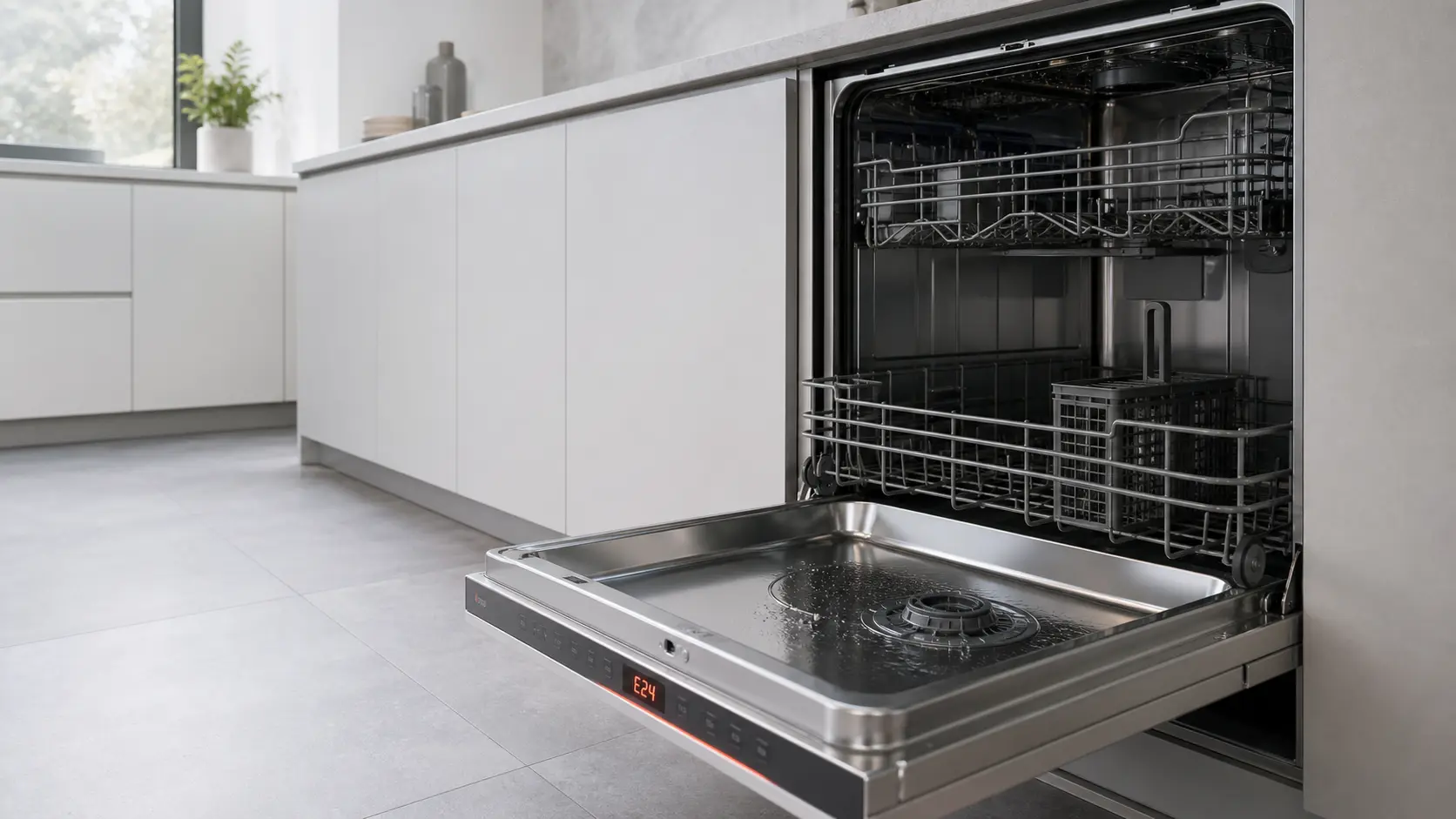
If your Bosch dishwasher displays E24, follow our Bosch dishwasher error code E24 guide for model-specific drainage checks.
7. A Leak Has Activated the Safety Float
Some dishwashers stop or run the drain pump continuously when water reaches a safety tray beneath the appliance. You may hear a pump running even when the dishwasher is off, or see water around the base. Turn off the water supply and power, then arrange service rather than tilting or dismantling the appliance. The leak source could be a hose, pump, door seal, inlet valve, or internal component.
8. A Failed Circulation Pump, Drain Pump, or Heating Component
If the dishwasher fills but does not spray water, a circulation pump or motor problem may be involved. If it washes but will not drain, a drain pump may be blocked or failing. A cycle that stops near the end, leaves dishes cold and wet, or displays an error code can also be related to the heating circuit, thermostat, sensor, wiring, or control board. These repairs typically require testing with the appliance disconnected from power.
9. A Faulty Control Board or User Interface
A blank display, flashing lights, buttons that do not respond, or a dishwasher that starts and stops unpredictably can point to a failed user interface or electronic control board. Moisture, a power surge, loose wiring, and normal component wear can all contribute. Because electronic faults can resemble other problems, a technician should confirm the cause before parts are replaced.
When to Call a Dishwasher Technician
Book professional repair if the breaker trips repeatedly, there is a burning smell, the dishwasher leaks, the door will not latch, standing water keeps returning after the filter and accessible hose have been checked, or an error code returns after a reset. It is also a good idea to call when the dishwasher must be pulled out from cabinetry, when wiring or water lines need to be handled, or when the appliance is still under warranty.
To help the visit go smoothly, have the model number ready and note any error code, unusual noise, leak location, or point in the cycle when the problem happens. Appliance Trust provides dishwasher diagnosis and repair across Toronto and the GTA.
Need help now? Book a dishwasher repair online.